The Complete Commercial Solar Checklist for Australian Business Owners
Installing solar is a significant decision for any Australian business. The right commercial solar system can help a business generate electricity on-site, reduce reliance on grid power and improve long-term energy management. However, choosing the right system involves much more than selecting a few solar panels.
From analysing electricity consumption and checking your roof to choosing the right inverter, considering battery storage and reviewing installation requirements, there are several factors business owners should assess before committing to a commercial solar project.
This commercial solar checklist for Australian business owners covers the key steps to consider before, during and after your solar investment.
1. Review Your Business Electricity Usage
Before looking at solar panels or system prices, understand how your business currently uses electricity.
Review your recent electricity bills and identify:
- Average monthly and annual electricity consumption
- Your business’s peak electricity usage periods
- Current electricity rates
- Demand charges, if applicable
- Existing feed-in arrangements
- Seasonal changes in electricity consumption
- Major equipment that consumes significant power
The best commercial solar system size depends on factors including electricity consumption, when electricity is used, available roof space, budget and local conditions. The Australian Government recommends considering your business’s usage profile when determining an appropriate system size.
For many businesses, maximising the amount of solar electricity used on-site can be an important part of system design.
2. Determine the Right Commercial Solar System Size
Bigger does not automatically mean better.
Your commercial solar system should be designed around your business’s actual energy requirements, available installation area and financial objectives.
A professional assessment should consider:
- Available roof area
- Roof orientation and pitch
- Shading from nearby buildings or structures
- Current electricity consumption
- Future changes in business operations
- Solar panel capacity
- Inverter capacity
- Potential grid export limitations
- Battery storage requirements
The Australian Government’s SunSPOT calculator can also provide an independent estimate of suitable solar system size, estimated costs, savings and payback considerations for eligible businesses.
A qualified solar professional can then develop a site-specific design based on your property’s characteristics and electricity profile.
3. Inspect Your Commercial Roof
Your roof is one of the most important parts of a commercial solar installation.
Before installation, check:
- Roof condition
- Roof age
- Available installation area
- Structural suitability
- Roof orientation
- Shading
- Access for installation and maintenance
- Potential areas requiring repair
Installing solar on a roof that requires major repairs may create additional costs later.
A site inspection can also identify access challenges, switchboard issues, cable-routing requirements and other installation considerations before work begins. Australian Government guidance recommends obtaining site-specific assessments and asking installers to identify potential complications before accepting a quote.
4. Choose the Right Solar Panels
Solar panels are only one component of a commercial solar system, but their quality and suitability matter.
When comparing panels, consider:
- Manufacturer reputation
- Product specifications
- Efficiency
- Warranty terms
- Performance characteristics
- Suitability for your roof
- Availability of replacement or support services
Rather than choosing a system based solely on the lowest upfront price, compare the complete solution, including equipment quality, installation, warranties and after-sales support.
5. Pay Close Attention to the Solar Inverter
The solar inverter is a critical component of your commercial solar system. It converts the electricity generated by the solar panels into electricity that can be used by your business.
WelsSolar offers commercial solar inverter options from recognised manufacturers including GoodWe, Fronius, AlphaESS and Sungrow, alongside other inverter solutions.
When selecting a commercial solar inverter, consider:
- Inverter capacity
- Efficiency
- Number of MPPT inputs
- Monitoring capabilities
- Compatibility with your solar panels
- Battery compatibility
- Warranty
- Manufacturer support
- Future expansion requirements
Australian businesses should also ensure the inverter model and installation meet applicable Australian requirements. The Clean Energy Council maintains an approved inverter product list and notes that the updated AS/NZS 4777.2:2020 Amd 2:2024 inverter standard came into effect on 23 August 2025.
6. Consider Commercial Battery Storage
Solar panels generate electricity during daylight hours, but your business may continue using electricity after the sun goes down.
A commercial battery can store excess solar energy and make it available later. Depending on the business’s electricity tariff and usage profile, battery storage may also help manage periods when electricity costs more or reduce peak demand in some circumstances.
Before adding a battery, assess:
- Your daytime electricity consumption
- Evening and overnight electricity usage
- Battery capacity
- Battery power output
- Expected cycling requirements
- Available installation space
- Backup power requirements
- Compatibility with your inverter
- Warranty and support
- Total project economics
Battery storage has a significant upfront cost, so it should be assessed against your specific energy profile rather than added automatically to every commercial solar project.
7. Check Your Switchboard and Electrical Infrastructure
A commercial solar installation may require electrical infrastructure upgrades.
Your installer should assess:
- Main switchboard
- Existing electrical equipment
- Cable capacity
- Protection equipment
- Metering requirements
- Connection requirements
- Available space for solar equipment
- Potential upgrades
Identifying these requirements early can help prevent unexpected installation costs.
The Australian Government notes that switchboard or other electrical infrastructure work may need to be completed before a solar system can be connected and switched on.
8. Understand Grid Connection and Export Limits
Your solar system does not operate independently of the electricity network.
Depending on your location and system design, you may need to consider:
- Distribution network requirements
- Connection applications
- Export limits
- Metering
- Network approvals
- System configuration
Your installer should explain the connection process and any applicable export limitations before you proceed.
Connection requirements can vary according to the local electricity network, so avoid assuming that a system design suitable for one property will automatically be suitable for another.
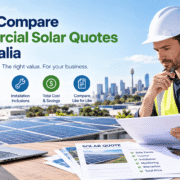
9. Compare Commercial Solar Quotes Carefully
Price is important, but it should not be the only factor.
When comparing commercial solar quotes, look for:
- Solar system size in kW
- Solar panel make and model
- Inverter make and model
- Battery details, if applicable
- Installation costs
- Electrical upgrades
- Monitoring equipment
- Expected electricity generation
- Estimated savings
- Payback assumptions
- Grid connection costs
- Warranties
- Maintenance and support
- Payment terms
- Any exclusions
Australian Government guidance recommends comparing quotes on more than price and checking the equipment, warranties, installation requirements, expected output and assumptions behind projected savings.
Getting multiple quotes can also make it easier to identify major differences in system design and pricing.
10. Check Installer Accreditation and Experience
Commercial solar installations require appropriate technical expertise.
Before selecting an installer, check:
- Relevant accreditation
- Electrical licensing requirements
- Experience with commercial projects
- Previous installations
- Product knowledge
- Warranty support
- Local service availability
- Insurance
- Customer reviews
Australian Government guidance states that accredited installers are trained to ensure rooftop solar and battery systems meet industry best practice and relevant Australian standards.
For businesses, experience with larger systems and commercial electrical infrastructure can be particularly valuable.
11. Review Warranties and After-Sales Support
Your solar investment is designed to operate for many years, so consider what happens after installation.
Review warranties for:
- Solar panels
- Inverters
- Batteries
- Installation workmanship
- Monitoring equipment
Also ask:
- Who handles warranty claims?
- Is local technical support available?
- How are faults reported?
- What monitoring is provided?
- Is ongoing maintenance available?
A lower-cost system may not provide the same level of support as another quote, so make sure you understand exactly what is included.
12. Consider Your Business’s Future Energy Needs
Your energy requirements may change as your business grows.
You may add:
- New machinery
- Refrigeration
- Electric vehicles
- EV chargers
- Additional offices
- Warehouse equipment
- Production capacity
- Battery storage
For this reason, it can be useful to discuss future electricity requirements when designing your commercial solar system.
A scalable approach may make future upgrades easier, depending on the system architecture and available electrical capacity.
13. Check Available Government Incentives
Australian businesses may be eligible for government assistance depending on the type, size and location of their solar or battery installation.
The Australian Government’s Small-scale Renewable Energy Scheme (SRES) can reduce the cost of eligible small-scale renewable energy systems through small-scale technology certificates. Eligibility depends on the system and applicable requirements.
State, territory and local programs may also change over time.
Before relying on an incentive in your financial calculations, confirm current eligibility and requirements with the relevant government authority and your tax or financial adviser.
14. Calculate the Commercial Solar Business Case
A commercial solar project should be assessed as a business investment rather than simply an equipment purchase.
Consider:
Upfront investment
Equipment + installation + electrical work + other project costs
Potential savings
Solar electricity used on-site + applicable value from exported electricity
Other financial considerations
Battery storage + financing + maintenance + incentives + future electricity prices
Your projected payback period and return will depend on your individual system, electricity usage, tariffs, installation costs and other assumptions.
Avoid relying on a generic payback figure advertised for another business. A site-specific assessment will provide a more meaningful picture.
15. Plan for Solar Monitoring and Maintenance
Once your commercial solar system is installed, monitoring can help you understand how it is performing.
Depending on your equipment, monitoring may provide information about:
- Solar generation
- Energy consumption
- Grid imports
- Grid exports
- Battery charging and discharging
- System alerts
- Historical performance
Regularly reviewing your system can help you identify unusual performance or faults sooner.
16. Commercial Solar Checklist: Before You Sign
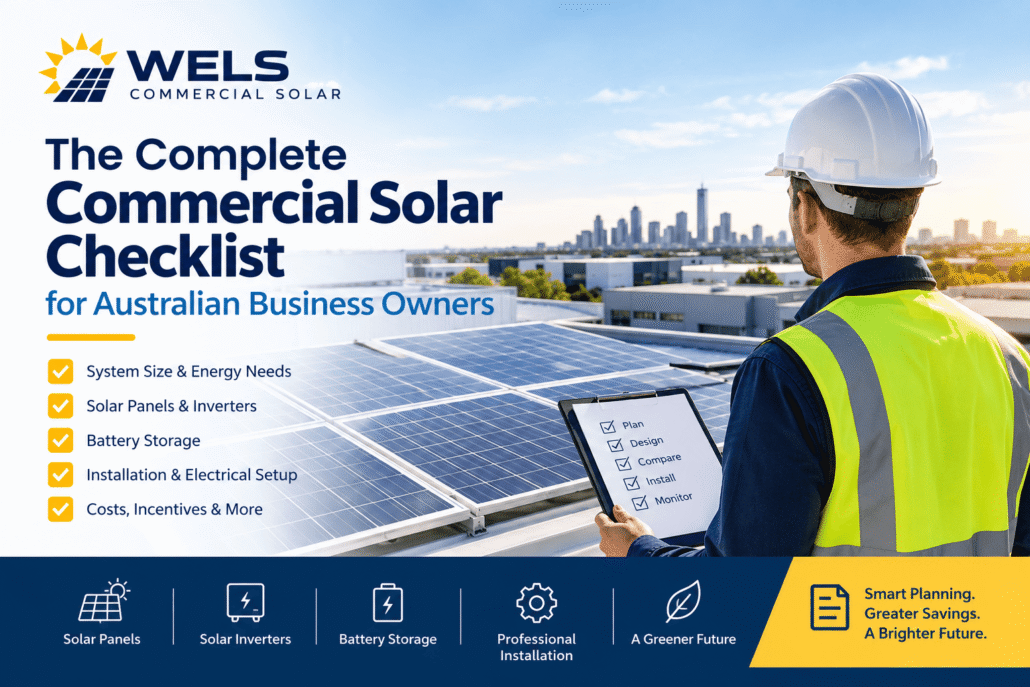
Before accepting a commercial solar proposal, use this checklist:
☐ Review your electricity bills and usage profile
☐ Determine your current and future energy requirements
☐ Assess available roof space
☐ Check roof condition and access
☐ Review solar panel specifications
☐ Compare commercial solar inverters
☐ Consider whether battery storage is appropriate
☐ Check switchboard and electrical infrastructure
☐ Understand grid connection requirements
☐ Confirm potential export limitations
☐ Obtain detailed, site-specific quotes
☐ Check installer accreditation and licensing
☐ Review equipment and workmanship warranties
☐ Check after-sales support
☐ Understand all project costs and exclusions
☐ Investigate applicable government incentives
☐ Review projected generation and savings assumptions
☐ Consider future expansion requirements
☐ Confirm monitoring arrangements
☐ Understand maintenance and service options
Why Choose WelsSolar for Commercial Solar?
Choosing the right solar partner is an important part of a successful commercial solar project.
WelsSolar provides solar and energy solutions for homes and businesses across Sydney and NSW, including solar systems, battery storage, solar inverters and EV charging solutions. Its inverter offering includes products from brands such as GoodWe, Fronius, AlphaESS and Sungrow.
For businesses considering commercial solar, the goal should be to develop a system that matches current electricity consumption while allowing room for future energy requirements.
A professional site assessment and properly designed system can help you make a more informed investment decision.
Start Your Commercial Solar Journey
Commercial solar is a long-term investment, so taking the time to plan properly can make a significant difference.
The right approach starts with understanding your electricity usage, assessing your property, selecting suitable equipment and comparing complete installation proposals—not simply choosing the cheapest quote.
If your business is considering solar, battery storage or a commercial solar inverter, speak with a qualified solar professional to discuss your site’s requirements and potential system design.
Ready to explore commercial solar for your business?
Contact WelsSolar to discuss a commercial solar solution for your business in Sydney and NSW.
FAQs About Commercial Solar
1. What is a commercial solar system?
A commercial solar system is a solar photovoltaic (PV) installation designed to generate electricity for a business or commercial property. The electricity generated can be used by the business, with eligible excess electricity potentially exported to the grid.
2. How do I choose the right commercial solar system size?
The appropriate system size depends on your electricity consumption, when your business uses energy, available roof space, budget, local network requirements and future energy needs. A site-specific assessment can help determine an appropriate system size.
3. Are solar batteries worth it for a business?
A commercial battery may be useful when a business has substantial electricity consumption outside solar-generation hours or wants to manage certain periods of higher electricity costs. However, battery economics vary by business, so the system should be assessed against actual energy usage and tariffs.
4. What should I look for in a commercial solar inverter?
Consider inverter capacity, efficiency, monitoring, MPPT configuration, battery compatibility, warranty, manufacturer support and compliance with applicable Australian requirements. The Clean Energy Council maintains an approved inverter product list.
5. Do commercial solar systems need grid approval?
Grid connection requirements depend on the property, system and local electricity network. Your solar installer should identify applicable connection requirements, metering arrangements and export limitations as part of the project.
6. How many solar quotes should a business get?
Getting multiple detailed quotes can help a business compare system designs, equipment, installation requirements, warranties and costs. The Australian Government recommends getting quotes from at least three suppliers where practical.
7. What should a commercial solar quote include?
A detailed quote should identify the system size, equipment brands and models, site-specific design, installation costs, additional electrical work, estimated generation or savings, warranties, payment terms and applicable connection or export information.
8. Can a business install solar if it rents its premises?
Potentially, but additional considerations may apply. A business leasing its premises should discuss the proposed solar installation with the property owner and review the lease arrangements before proceeding.
9. Does commercial solar require maintenance?
Solar systems generally benefit from ongoing monitoring and appropriate maintenance. Monitoring can help identify changes in generation or system faults, while professional inspections can help maintain system performance over time.
10. Is commercial solar available for warehouses and factories?
Yes. Warehouses, factories, offices, retail premises and other commercial properties can potentially use rooftop solar. The appropriate system depends on the property’s electricity demand, roof characteristics, available installation area and electrical infrastructure.
Final Commercial Solar Checklist
Before investing, remember the key steps:
Analyse → Design → Compare → Verify → Install → Monitor
Analyse your energy use, design a system around your business, compare detailed proposals, verify equipment and installer credentials, complete the installation correctly and monitor the system after commissioning.
With careful planning, commercial solar can become an important part of a business’s long-term energy strategy.